OpenJevSwift

Open source by Algorythm · Apache-2.0

Typed AI decisions, running locally on Apple devices.

An open-source Swift implementation of OpenJev. It brings probability-based yes/no, choice, and score answers into iPhone and Mac applications, with a compatible HTTP server for existing integrations.Typed decisions and native inference demonstrate our AI software engineering for local applications.

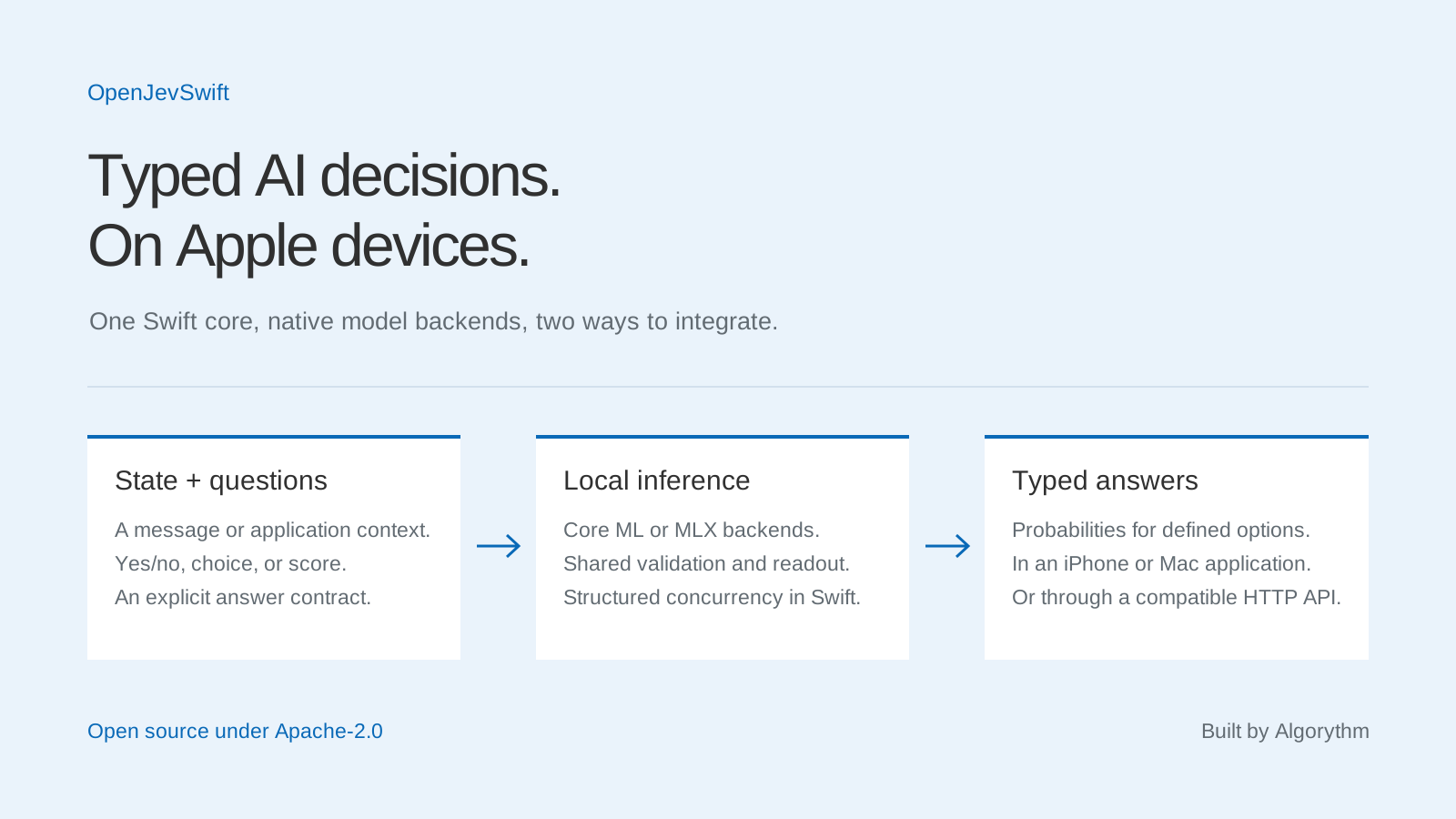
OpenJevSwift reference flow: state and typed questions enter native local inference, returning option probabilities to an application or HTTP client
Reference flow. A shared Swift core connects typed questions to local inference and structured answers.

The challenge

Many application decisions need a bounded answer: whether a message needs attention, which team should receive it, or where it falls on a scale. Bringing that behavior onto Apple devices requires more than translating an HTTP endpoint. The implementation must preserve the request contract, reproduce model readout behavior, manage local model files, and make numerical differences visible across runtimes.

Our approach

We separated a Foundation-only decision core from the model backends, server, and command-line interface. Core ML serves the encoder models; MLX supports the larger Apple silicon backends. Golden fixtures, checkpoint comparisons, and device tests check compatibility at the appropriate level. A native triage demo puts the public library API into a real iPhone interaction.

The engineering approach

How the experience connects to the application, data, and processing behind it.

3 answer typesunder an explicit contract
Yes/no (noul), choice, and ordered score questions return bounded probability-based answers.
4 backendsbehind native Swift interfaces
Verdict and Laya on Core ML; DiffusionGemma and JevK5 on MLX.
Apache-2.0for the open-source implementation
Public source, compatibility records, tests, documentation, and model attribution.

The first boundary is between a decision contract and the inference implementation. OpenJevCore contains the request and answer types, schema validation, prompt and template construction, probability processing, and engine policies. It depends on Foundation and builds on macOS, iOS, and Linux. Applications can link the core and a backend without pulling the HTTP server into an iPhone build.

The model adapters serve different readout strategies. Verdict and Laya run through Core ML. DiffusionGemma and JevK5 use MLX on Apple silicon. Protocols isolate those model-specific paths from the public contract. Swift 6 strict concurrency and actor-isolated engines make ownership and concurrent work explicit, while server admission and runtime limits bound the work a deployment accepts.

Compatibility is tested in layers. Upstream Python produces golden fixtures for wire responses, validation errors, prompts, tokenization, seeded canvases, and decision policies. Model-free tests can check those contracts without downloading weights. Live checkpoint tests then compare inference behavior, using exact equality only where the reference conditions support it and measured bounds for native kernels.

The application experience is part of the engineering. TriageDemo uses the public library API, debounces input, cancels outdated reads, and presents each option’s probability. Its model store verifies downloads before keeping them. Tests cover request bytes, answers against a Mac reference, and accessible labels in the interface. Package documentation, dependency pins, and recorded compatibility decisions make those boundaries available to other developers.

Where this approach is useful

From the implemented demo to ways a team can apply the same library boundary.

Customer-message triage in an iPhone app

The implemented demo asks whether a message needs a reply within an hour, which team should handle it, and how upset the customer sounds. The person sees distributions over the permitted answers as they type. The demo is a concrete example of native interaction design around local inference.

A local decision service for existing clients

A Mac can run openjev serve behind the Jev-compatible API, or answer a single request through openjev decide. This provides an integration path for tools that already speak the wire contract, while keeping inference in the local process and its configured model runtime.

Bounded checks inside business software

The same embedding pattern can support a fixed routing decision or an ordered assessment in another product. Define the permitted answers, evaluate domain examples, and decide when a person should review a close or uncertain result before allowing it to affect the business process.

A request that defines the answer space

This request uses the public systemone contract. The caller defines the choice options; the backend returns a choice and its probability distribution. Applications can make the same request through the Swift library instead of HTTP.

JSON request · POST /v1/systemone

{
  "model": "jev-latest",
  "state": "I was charged twice this month.",
  "questions": {
    "team": {
      "type": "choice",
      "instructions": "Which team should handle it?",
      "criteria": {
        "outage": "service down",
        "billing": "charges, refunds",
        "feature": "requests, how-to"
      }
    }
  }
}

High-level architecture

The application and the HTTP server are separate entry points to the same decision contracts. The diagram follows the inference path; model preparation, package downloads, and operations sit around it.

Reviewed implementation, simplifiedA portable decision core with native inference adapters
  1. App or HTTP client

    A native Swift caller or Jev-compatible request supplies state and typed questions.

  2. OpenJevCore

    Validation, question schemas, decision policies, and answer assembly.

  3. Core ML or MLX

    The chosen backend performs its model-specific probability readout locally.

  4. Typed decision

    The caller receives defined answers, distributions, and usage information.

The core’s Foundation-only boundary keeps inference and transport dependencies separate. The server and CLI translate deployment settings into typed configuration; an embedding application owns its own setup and product behavior.

Follow the data through the workflow

The iPhone demo asks about urgency, routing, and tone. It uses a local Verdict model after the initial verified download, with a cancellation-aware interface around the read.

Workflow and data flowFrom a customer message to inspectable triage answers
  1. Enter a message

    A short pause after typing schedules a read; further input cancels pending work.

  2. Build the request

    The view model supplies a yes/no, a team choice, and an ordered tone question.

  3. Read on device

    The actor-based encoder engine runs the model and assembles the permitted answers.

  4. Show the distribution

    The interface presents option bars, confidence, model identity, and model time.

A cancellation check prevents an obsolete read from publishing its result. If a question type is refused, the demo tests questions individually, retains supported questions, and explains the omitted ones.

Integrations & responsibilities

Each connected system has a specific role. These boundaries explain where information moves and which part of the application owns the next step.

Native Swift application

Link OpenJevCore and the required backend module through Swift Package Manager.

The app owns the interaction, permission model, business rules, and the meaning of a decision in its workflow.

Jev-compatible HTTP API

The Hummingbird server and openjev CLI expose local decisions to existing clients.

Request shapes, headers, model listing, and error behavior are part of the compatibility work. An API-compatible response does not imply that every backend has the same task accuracy.

Model package and artifact stores

The encoder store obtains model packages, tokenizers, and calibrators, checking size and SHA-256 against its embedded manifest.

The initial setup needs network access. Checked local files support later offline use; model weights and their licenses remain separate from the Swift source license.

Upstream fixtures and public evaluations

Reference fixtures, checkpoint comparisons, and benchmark harnesses provide evidence at different layers.

Wire compatibility, numerical parity, model accuracy, latency, and calibration are measured separately so one result is not used to stand in for another.

Decisions and tradeoffs

Read a defined answer space from probabilities

The typed decision API limits the answer to the supplied yes/no, choice, or score contract. This avoids making a prose response responsible for its own output schema.

The tradeoff

Structural validity does not establish substantive correctness. Thresholds, ambiguity handling, and the consequences of an answer still need evaluation on the application’s workload.

Keep exact conformance separate from native numerical behavior

Pure Swift contracts are checked against upstream fixtures. Model reads have their own exact-reference conditions and native-runtime comparisons, with the differences recorded publicly.

The tradeoff

Floating-point precision, quantization, and kernels can change probabilities and close decisions. A useful port needs explicit bounds and difficult examples instead of a blanket equivalence claim.

Use a verified model store and a small embedding surface

The package keeps the core independent of the server and verifies model artifacts before retaining them. The iPhone demo uses the same public interfaces an embedding app would use.

The tradeoff

First-run download, compilation, memory, model support, and device capability become part of the application’s setup experience. The four backends have different operating requirements.

What the implementation delivers

The outcomes below describe the product capabilities established by this case study. The measured results retain their reference comparisons and test conditions.

An inspectable native AI foundation

Swift applications can embed typed decisions, while a Mac process exposes compatible HTTP endpoints and command-line operation. Transport, shared contracts, and model execution have separate responsibilities.

A working on-device use case

TriageDemo classifies customer messages with visible probabilities, input cancellation, and progress/error handling for model setup. Its documentation records later offline use on a physical iPhone.

Reproducible engineering evidence

The public repository includes conformance fixtures, model comparison results, benchmark methods, architecture decisions, DocC documentation, and tests. Contributors can inspect both the implementation and the limits of its reported results.

Measured results

The repository reports these results under defined conditions. The desktop measurements use an Apple M3 Max with 128 GB on macOS 27.0.1. The quality comparison was run on October 1, 2026; the read benchmark on October 1; and the device comparison on October 6. Each result answers a different engineering question.

666 / 666top answers agreed with upstream

Verdict and Laya across 231 JevBench items and 102 TypeSafe evaluation rows per model. This is agreement between the Swift and upstream servers, with the Core ML and reference configurations described in the report; it is not a 100% accuracy result.

Read the method and results
301.6 msmedian three-question local read

DiffusionGemma 26B-A4B, 4-bit, in-process on the M3 Max. Fifty timed reads followed five untimed requests, with a new input state for each request and one caller at a time. The 95th percentile was 327.7 ms.

Read the method and results
0.0023largest probability difference in the device comparison

The iPhone 13 Pro Max on iOS 27.0 was compared with Mac answers for the demo’s three sample messages. All demo test groups passed. This absolute probability difference describes those samples and that comparison.

Read the method and results

Technology used in the implementation

The principal technologies in the reviewed source, grouped by their role in the product.

Language and package
Swift 6 language mode, strict concurrency, Foundation, Swift Package Manager
Apple model execution
Core ML for Verdict and Laya; MLX Swift for DiffusionGemma and JevK5
HTTP and command line
Hummingbird 2, SwiftNIO, Swift Argument Parser, Swift Service Lifecycle
Native demo
SwiftUI, Observation, actor-based decision engine, structured concurrency, XCTest UI checks
Verification and documentation
Golden JSON fixtures, Python reference/oracle tools, checkpoint tests, public benchmark harnesses, DocC, GitHub Actions

Explore the source and evidence

Follow the design, implementation, and verification in the public repository. These references point to the reviewed source revision.

Bring us your challenge.

Need local AI inside a native application?

Get a project consultation